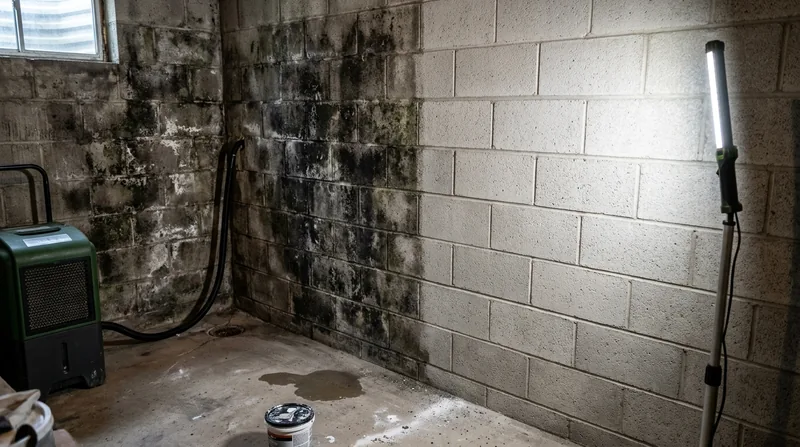




Basement Mold Remediation in Memphis: Fix the Moisture, Then the Mold
Memphis sits on the Mississippi River bluff over deep loess silt and Memphis sand, and that geology drives nearly every mold problem we see below grade. The long humid summers push indoor humidity past 60 percent for weeks, and a single thunderstorm downpour can push the water table near the Wolf River and Nonconnah Creek against a foundation wall overnight. When Basement Mold Remediation in Memphis is done right, it starts with finding the water source, not with spraying bleach on the studs. Full basements are uncommon in Midtown and Cooper-Young, so most growth we find shows up as damp lower walls, musty slab edges, and fuzzy patches behind baseboards in raised pier-and-beam and masonry crawl-height homes. In Germantown, Collierville, and Bartlett, the 1990s to 2020s brick-veneer slab homes hide moisture behind finished drywall until the smell gives it away. We pair containment and surface treatment with the drainage or dehumidification fix that keeps it from returning. Call (901) 519-3853 for a free inspection, or read our basement waterproofing page to see how the moisture side is handled.
Why Mold Grows Below Grade in Memphis Homes
Mold needs three things: moisture, organic material, and still air. Memphis delivers all three in the lower level. The shrink-swell clay pockets in the loess hold water against the footing, hydrostatic pressure pushes it through hairline cracks and cold joints, and the humid summer air condenses on cool concrete. In Midtown and Central Gardens, the 1910s to 1930s brick bungalows often have a damp masonry base and efflorescence on the lower courses, which is the white salt bloom that tells you water is moving through the wall. In Whitehaven, Berclair, and Hickory Hill, the 1950s to 1970s brick ranches on slabs show wet slab edges and mold behind the drywall at the floor line. Add a failed sump pump during a flash flood and you have a colony starting within 48 to 72 hours.
- Water seeping through foundation cracks and cold joints feeds mold along the baseboard line.
- High indoor humidity in July and August condenses on cool basement walls and slab edges.
- A failed sump pump or clogged discharge line leaves standing water after a storm.
- Poor grading and short downspouts dump roof water against the foundation instead of away from it.
- Window wells that fill with silt and leaves hold water against the wall below grade.
Each of these is a moisture problem first and a mold problem second, and treating the surface without fixing the source only buys a few months.
Key info: A 1920s bungalow in Cooper-Young with efflorescence on the lower brick and a musty smell in the rear room usually has water coming through the wall, not a roof leak. We see the same pattern in Central Gardens and Evergreen, and the fix is drainage and wall sealing, not another coat of paint.
For the building-science side of moisture and mold, the U.S. Environmental Protection Agency publishes guidance at epa.gov/mold, and local permit questions go to the Shelby County government or the City of Memphis building department.
How We Run a Basement Mold Remediation in Memphis
We do not treat mold until we know where the water is coming from. The first visit is a moisture diagnostic: we read the walls with a pin meter, check the slab edges, test the sump basin and check valve, and trace the musty smell to its source. Then we build a containment, remove or treat the affected material, and correct the moisture path so the growth does not come back. The sequence matters more than the chemicals.
- We inspect the basement, the foundation walls, the window wells, and the grading, and we document moisture readings room by room.
- We set up poly containment and negative air pressure so spores do not travel into the living space during work.
- We remove porous material that cannot be saved and treat structural surfaces with an antimicrobial product.
- We correct the water path with crack injection, interior perimeter drain, sump pump repair, or grading and downspout changes.
- We run dehumidification to bring the lower level under control for Memphis' humid summers.
- We re-test moisture and confirm the musty smell is gone before we close out the job.
If the water is coming through a wall crack, we use epoxy or polyurethane injection rather than a patch, because a patch on a wet wall fails within a season.
Key info: A finished basement in Cordova with mold behind the drywall at the slab edge usually needs the lower 12 to 24 inches of drywall removed, the slab edge dried, and an interior drain tile system installed before the wall goes back up. We see the same setup in Collierville and Germantown subdivisions.
When the water source is a failed sump, we handle the pump side through our sump pump installation and replacement service, and when the wall itself is the path, our foundation crack repair team injects and seals it. For a neighborhood-specific look, see our Memphis 38104 page.
Remediation Methods We Use in Memphis
No two moisture problems are the same, and the method follows the diagnosis. Here is how the main approaches compare for the housing stock and soils we work in across the Memphis metro.
| Approach | Description | Best for |
|---|---|---|
| Containment and surface treatment | Poly sheeting, negative air, HEPA vacuuming, and antimicrobial treatment of structural surfaces. | Surface growth on joists, walls, and framing after a single water event. |
| Material removal and rebuild | Cutting out wet drywall, insulation, and trim, then drying the framing before closing up. | Finished basements in Cordova, Germantown, and Collierville with wet slab edges. |
| Crack injection | Epoxy or polyurethane injected through ports to fill the crack full depth. | Hairline and shrinking cracks in poured walls where water seeps after rain. |
| Interior perimeter drain and sump | Drain tile at the footing inside the basement, feeding a sump basin and pump. | Hydrostatic pressure and a high water table near the Wolf River and Nonconnah Creek. |
| Dehumidification and ventilation | Sized dehumidifier and air movement to hold the lower level below the condensation point. | Humid summer air and cool concrete walls in Midtown and Central Gardens. |
Basement Mold Remediation Cost in Memphis: What to Expect
Most basement mold remediation jobs in Memphis start from $1,500 for a contained treatment of a limited area with the moisture source corrected. The price moves with the square footage affected, how much porous material has to come out, whether the basement is finished, and what drainage work the moisture fix requires. A surface treatment in an unfinished Whitehaven basement is a different job from cutting out drywall in a finished Cordova basement and installing an interior drain tile system. We give you a written scope with the moisture fix broken out separately so you can see what the remediation costs and what the prevention costs.
Get two or three estimates, ask each contractor to explain the water source in plain terms, and be wary of anyone who quotes a treatment without testing moisture first. Our pricing overview lays out the ranges for the drainage and pump work that usually accompanies remediation.
Choosing a Basement Mold Remediation Contractor Near Me in Memphis
Mold work is only as good as the moisture diagnosis behind it, so hire for the diagnosis, not the sprayer. Ask for proof of licensing and insurance, ask how they will contain the work area, and ask what they will do about the water that caused the growth. A contractor who cannot explain the difference between a wall seep and hydrostatic pressure is guessing.
- Confirm the company is licensed and insured and ask for a certificate before work starts.
- Get two or three written estimates with the moisture fix itemized separately from the treatment.
- Ask for local references from jobs in Memphis, Bartlett, or Germantown similar to yours.
- Ask whether the scope requires a permit, since structural repair and drainage changes can trigger one and rules vary by jurisdiction.
- Check HOA requirements in your subdivision before exterior drainage or grading changes.
We are a dedicated below-grade waterproofing specialist, not a general foundation firm or a plumber, and we will tell you when simple crack sealing is enough and when the real answer is an interior drain tile system. Reach out through our contact page or call (901) 519-3853 to schedule a free inspection.
Basement Mold Remediation in Memphis: Pricing Guide
| Service | Price | Details |
|---|---|---|
| Contained surface treatment | Starting at $1,500 | Includes containment, HEPA vacuuming, antimicrobial treatment of structural surfaces, and moisture re-test. |
| Treatment plus material removal | Starting at $2,400 | Adds cutting out wet drywall and insulation and drying framing; finished basements push the price up. |
| Mold remediation with drainage correction | On estimate | Crack injection, interior drain tile, or sump work is scoped separately after the moisture diagnostic. |
| Travel | Included | In Memphis and surrounding areas, no separate call-out or mileage fee. |
| Estimate | Free | Response within 24h at (901) 519-3853, no obligation to book. |
Indicative pricing, the exact cost depends on square footage, finish, and site access. Free personalized estimate within 24h at (901) 519-3853.


