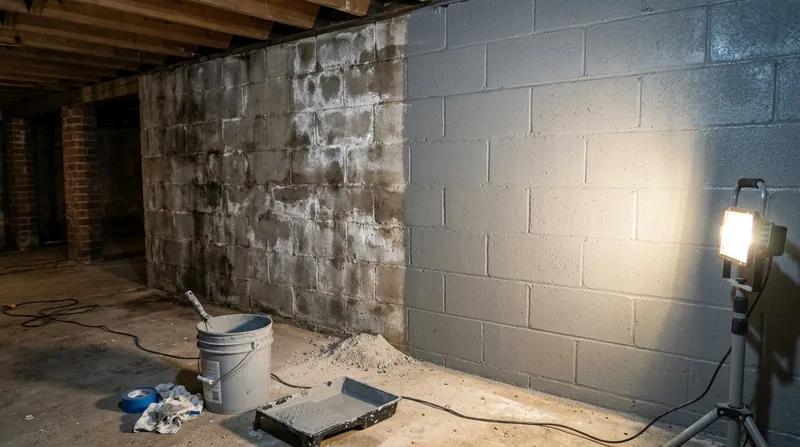




Basement Wall Sealing in Memphis: What Damp Lower Walls Really Need
Memphis sits on the Mississippi River bluff over deep loess silt and Memphis sand, and that geology decides how water behaves in your basement. The windblown silt holds moisture, the shrink-swell clay pockets move it sideways, and the high water table near the Wolf River and Nonconnah Creek pushes it against your footing. Basement Wall Sealing in Memphis is the right first step when you see damp patches, chalky white efflorescence, or a musty smell after a summer downpour, not when water is running across the floor.
Most homes here are 1910s to 1930s brick Craftsman bungalows in Midtown and Cooper-Young, 1950s to 1970s brick ranches on slabs across Berclair and Whitehaven, and 1990s to 2020s brick-veneer subdivisions in Germantown and Collierville. True full basements are uncommon, so the water shows up as wet lower walls, damp slab edges, and window wells that fill during a thunderstorm. We look at what the wall is telling us before we sell you a sealer. If you want the full picture of how sealing fits into a dry basement, start with our basement waterproofing service.
Why Damp Basement Walls Show Up So Often in Memphis Homes
The dominant failure mode in this city is not a single cracked wall. It is hydrostatic pressure from a high water table and clay that swells after a storm, pushing moisture through porous mortar and block. Long humid summers keep the wall damp, and rare freezing nights drive freeze-thaw movement at the grade line. The result is efflorescence, peeling paint, and a musty smell that comes back every July.
- Brick and masonry walls in Central Gardens and Evergreen wick moisture through old mortar joints.
- Slab-on-grade ranches in Hickory Hill show damp slab edges where grading drains toward the house.
- Brick-veneer homes in Bartlett and Cordova get seepage at the sill plate and window wells.
- Downspouts that dump next to the foundation saturate the loess silt within one wet season.
Sealing helps when the wall is damp but not actively weeping, and we tell you plainly when that is the case.
Key info: A 1928 bungalow in Cooper-Young with white efflorescence and no standing water is a sealing job. The same wall with water running at the cove joint after a storm is a drainage job, and a sealer alone will fail within a season.
For the official word on what work needs a permit in this jurisdiction, check the Shelby County government building department before any structural or drainage alteration.
How We Seal Basement Walls in Memphis, Step by Step
We start with a free inspection to find where the moisture is coming from. Is it a hairline crack, a porous block wall, or pressure at the footing? That answer decides the method. We do not apply a membrane over an active leak, because trapped water finds another path and pushes the coating off.
- We inspect the wall, the cove joint, the window wells, and the grading on all four sides.
- We remove efflorescence and loose parging with a wire brush and a masonry cleaner.
- We fill cracks and voids with hydraulic cement or epoxy injection where the crack is structural.
- We apply a penetrating sealer on porous block or a waterproof membrane on damp masonry, depending on the wall.
- We extend downspouts and correct grading so the water leaves the foundation.
If the inspection shows pressure rather than surface dampness, we say so and point you to the right fix instead of sealing over a problem.
Key info: A Germantown brick-veneer home had damp sill plates and a musty smell every August. The cause was two downspouts discharging at the corner and a window well with no drain. Sealing the wall plus fixing the discharge solved it without excavation.
When the wall is bowing or the crack is wide, sealing is not the answer. See our foundation crack repair page for epoxy and polyurethane injection options.
Sealing Methods We Use and When Each One Fits
No single product handles every wall. The table below shows what we apply and the condition it is built for, so you can see where your Memphis home lands before we arrive.
| Approach | Description | Best for |
|---|---|---|
| Penetrating sealer | Soaks into block and mortar and blocks capillary moisture without a surface film. | Damp block walls with efflorescence and no standing water. |
| Waterproof membrane | Flexible coating that bridges hairline cracks and resists moderate pressure. | Damp masonry walls and damp slab edges in ranches. |
| Epoxy injection | Ports inject structural epoxy into a crack to bond and seal it. | Settled or structural cracks in poured walls. |
| Polyurethane injection | Foam expands into wet cracks and stops active seepage. | Actively leaking cracks and cold joints. |
| Parging repair | Replaces crumbling mortar before any sealer goes on. | Old brick walls in Midtown and Central Gardens. |
We choose the method after the inspection, not before, because the wrong product on a pressured wall wastes your money.
Basement Wall Sealing Cost in Memphis: What to Expect
Most sealing jobs here start around From $1,500, and that figure covers surface prep, efflorescence removal, and a sealer or membrane on the affected walls. The final number depends on linear feet, wall height, how much parging has to be rebuilt, and whether we find active cracks that need injection first. A single damp wall on a Whitehaven ranch sits near the low end. A full perimeter on a 1930s Central Gardens home with crumbling mortar runs higher.
Access moves the price too. A wall behind a finished basement or a tight window well takes longer than an open wall. So does a home where grading has to be corrected before sealing will hold. We give you 2 to 3 estimates as a rule, and we encourage you to compare scope, not just the bottom line. Our pricing overview breaks down the ranges in more detail.
Finding Basement Wall Sealing Near Me in Memphis: What to Check
Hiring the right contractor matters more than the brand of sealer. Ask for proof of license and insurance, and get a written scope that names the method and the walls covered. A contractor who promises a dry basement with a sealer alone, without inspecting for pressure, is guessing.
- Confirm the company is licensed and insured and ask for a certificate before work starts.
- Get 2 to 3 written estimates with the same scope so you can compare fairly.
- Ask for references from Memphis jobs with the same wall type as yours.
- Check whether the work needs a permit from the local building department, since rules vary.
- Ask how they handle grading and downspouts, because sealing fails if water still runs at the wall.
When you are ready, reach out through our contact page and we will schedule a free inspection at (901) 519-3853.
Basement Wall Sealing in Memphis: Pricing Guide
| Service | Price | Details |
|---|---|---|
| Single wall sealing | Starting at $1,500 | Includes prep, efflorescence removal, and sealer on one wall; height and parging condition move the price |
| Full perimeter sealing | Starting at $2,800 | Covers all accessible walls; linear footage and access behind finishes are the main cost drivers |
| Crack injection add-on | Starting at $450 | Epoxy or polyurethane injection per active crack; number of ports and crack width set the final figure |
| Complex or large-scale job | On estimate | We need an on-site look when walls are bowing, parging is failing, or grading must be corrected first |
| Travel | Included | in Memphis and surrounding areas, no separate call-out or mileage fee |
| Estimate | Free | Response within 24h at (901) 519-3853, no obligation to book |
Indicative pricing, the exact cost depends on square footage, finish, and site access. Free personalized estimate within 24h at (901) 519-3853.


