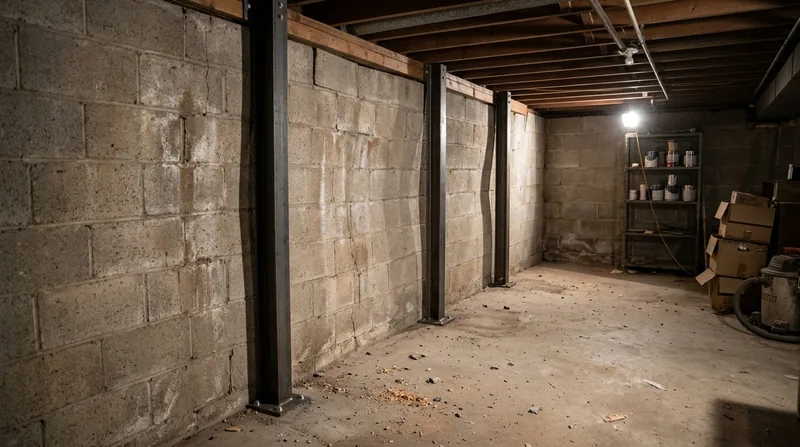




Bowing Wall Repair in Memphis: When Saturated Loess and Clay Start Pushing
If you have noticed a foundation wall leaning inward, a horizontal crack widening near the middle of a block wall, or a lower wall that bulges after heavy rain, you are looking at Bowing Wall Repair in Memphis, and the cause is almost always pressure from outside, not a cosmetic flaw. Memphis sits on the Mississippi River bluff over deep windblown loess silt and Memphis sand, with shrink-swell clay pockets and a high water table near the Wolf River and Nonconnah Creek. Full basements are uncommon here, so bowing shows up most often on older masonry foundation walls in Midtown, Cooper-Young, Central Gardens and Evergreen, and on sunken garage and lower-level walls in Berclair, Whitehaven and Hickory Hill. When saturated loess and clay press on a block or brick wall, the wall moves. We stop that movement and stabilize the wall with carbon fiber straps, steel I-beams or wall anchors matched to severity and soil. If you are still sorting out whether the water or the wall came first, start with a free basement inspection so we can read the whole picture before anyone sells you a repair.
Why Bowing Wall Repair Matters in Memphis Soil and Housing Stock
Memphis does not have a widespread true-basement market, so bowing walls are usually found on masonry foundation walls of 1910s-1930s Craftsman bungalows and Tudor cottages, on split-level lower walls, and on block walls behind sunken garages. The dominant failure mode is hydrostatic pressure: long humid summers, intense thunderstorm downpours and flash flooding in low neighborhoods push the water table up against the wall, and shrink-swell clay pockets load and unload the same wall season after season. Add the rare hard freeze and the freeze-thaw cycle works the mortar joints. A wall that leans a quarter inch is a monitoring job. A wall that has moved an inch or more, or shows a horizontal crack with displacement, needs stabilization now.
- We measure the actual deflection of the wall so the repair matches the movement, not a guess.
- We identify whether the load is soil pressure, water pressure or a failing footing drain before we anchor anything.
- We correct the water source, because a stabilized wall still takes pressure from a saturated yard.
- We document the wall before and after so you can see the movement stopped.
Stabilizing the wall without addressing the water is half a repair, and we say so up front.
Key info: In Central Gardens and Cooper-Young we routinely find block foundation walls with a horizontal crack at mid-height and efflorescence blooming on the interior face. That pattern means water has been pushing from outside for years. The wall needs straps or anchors, and the drainage needs attention.
Structural foundation repair permits are commonly required in Memphis and surrounding jurisdictions, and thresholds vary, so confirm the current requirement with the local building department before work starts. The Tennessee Board for Licensing Contractors is a useful state reference for verifying a contractor's license: Tennessee Board for Licensing Contractors.
How We Repair a Bowing Wall in Memphis, Step by Step
Every bowing wall job starts with a diagnosis, because a wall pushed by water and a wall pushed by soil need different corrections. We walk the interior face, check the wall for plumb and deflection, look at the footing drain and grading, and confirm where the water is coming from. Then we match the method to the severity: carbon fiber straps for a wall that has cracked but not rotated, steel I-beams for a wall that needs real bending resistance, wall anchors for a wall that has rotated and must be pulled back toward plumb. We do not excavate a Memphis yard unless the exterior is genuinely the right answer.
- We inspect the wall, the footing drain and the grading, and we record the deflection with measurements.
- We correct the water source first, which may mean an interior perimeter drain and sump basin or a discharge line fix.
- We install carbon fiber straps, steel I-beams or wall anchors based on how far the wall has moved.
- We seal active cracks and parge or membrane the wall face where water is still present.
- We re-measure the wall and hand you the before-and-after record.
The order matters: water first, then structure, then finish, which is why the wall stays put instead of moving again next spring.
Key info: A Bartlett brick-veneer home on slab had a sunken garage wall bowing inward about an inch after years of downspouts dumping at the corner. We extended the discharge, installed carbon fiber straps on the interior face and re-measured the wall at the end of the job. The movement stopped because the water stopped.
If the wall is moving because the drainage has failed, the structural repair pairs with interior drain tile to take the pressure off permanently.
Repair Methods We Match to Your Wall and Your Soil
There is no single fix for a bowing wall in Memphis, because loess, clay pockets and a high water table load walls differently from street to street. The table below shows how we choose. The right method is the least invasive one that actually stops the movement.
| Approach | Description | Best for |
|---|---|---|
| Carbon fiber straps | High-strength straps bonded vertically to the interior wall face and anchored top and bottom. | Cracked block walls with limited deflection and no rotation. |
| Steel I-beams | Vertical steel beams set against the wall and tied into the floor and joists. | Taller walls and heavier soil loads where bending resistance is needed. |
| Wall anchors | Exterior anchor plates tied through the wall to interior plates, tightened to pull the wall back. | Walls that have rotated and need to be brought back toward plumb. |
| Crack sealing and injection | Epoxy or polyurethane injection through ports to close active cracks and stop seepage. | Stable walls with leaking cracks that are not moving. |
| Drainage correction | Interior perimeter drain, sump basin and discharge line to relieve hydrostatic pressure. | Any bowing wall where water is the driving load. |
We tell you plainly when simple crack sealing is enough and when the real problem is hydrostatic pressure that needs drainage before structure.
Bowing Wall Repair Cost in Memphis: What to Expect
Bowing wall repair pricing starts at $600 for a limited scope, such as sealing and injecting an active crack on a wall that has not moved, and climbs from there as the method gets heavier. The honest variable is not the square footage of the wall, it is how far the wall has moved and what is loading it. A wall that needs carbon fiber straps on a short block foundation is a different job from a rotated wall that needs anchors and exterior excavation. Access matters too: a Midtown lot with a narrow side yard and mature trees costs more to work than an open Collierville subdivision lot. Getting two or three estimates is smart, not disloyal, because the diagnosis should match across bids. If one contractor quotes anchors and another quotes a tube of caulk, you have learned something. Our full pricing overview breaks down the ranges by method.
Bowing Wall Repair Near Me: How to Vet a Contractor Near Memphis
You are hiring a diagnosis as much as a repair, so vet the company on process, not on the truck wrap. Ask how they measure wall movement and whether you get the before-and-after record. Ask what they will do about the water, because a contractor who only sells straps is selling you half a repair. In older Memphis neighborhoods, check whether the work touches a protected tree canopy or a historic overlay, and confirm HOA requirements in the newer Germantown, Collierville and Cordova subdivisions before anything is installed. Structural foundation repair permits are commonly required and thresholds vary by jurisdiction, so verify with the local building department. When you are ready, contact us for a free estimate and we will tell you what the wall actually needs.
Bowing Wall Repair in Memphis: Pricing Guide
| Service | Price | Details |
|---|---|---|
| Crack sealing and injection only | Starting at $600 | Covers epoxy or polyurethane injection on a stable, non-moving wall crack, with the number of ports and crack length driving the price up. |
| Carbon fiber strap installation | Starting at $1,200 | Includes straps bonded to the interior wall face and anchored top and bottom, with wall height and strap count moving the total. |
| Steel I-beam or wall anchor system | On estimate | Heavier structural correction for rotated or heavily deflected walls, priced after we measure deflection and confirm soil load. |
| Drainage correction paired with structural repair | On estimate | Interior perimeter drain and sump work to relieve hydrostatic pressure, quoted with the structural scope because the two are designed together. |
| Travel | Included | In Memphis and surrounding areas, no separate call-out or mileage fee for the initial inspection. |
| Estimate | Free | Response within 24h at (901) 519-3853, no obligation to book the repair. |
Indicative pricing, the exact cost depends on square footage, finish, and site access. Free personalized estimate within 24h at (901) 519-3853.


